Friday, 24 June 2011

A skirmish at Battleship Cove

Location: 41 27.69 N 70 35.66 W

The wind and rain howled around us and we were soon soaked to the skin.  As it blew stronger, the anchor chain became horizontal and Ananda's bow sheared wildly from side to side, straining harder on the chain.  Fearful of the anchor dragging, I started the engine and motored into the gale to take off some of the tension.

We were anchored at Fall River and had just enjoyed a day spent exploring the warships at Battleship Cove, the world's largest naval ship exhibition.  For the last 20 minutes we had watched a large black cloud approaching, but all remained uncannily still.  It was as we climbed into our dinghy that a local man on a nearby yacht called over to us with the worrying news.

"50 to 60 knot winds, arriving in the next 10 minutes.  Best to get somewhere safe, maybe on land.  And you'd better move real fast!"

 What?  60 knots?  We could scarcely believe what we were hearing.

The outboard sprang into life and we sped over to 'Ananda' and winched the dinghy out of the water as quickly as we could.  Within a minute the storm was upon us.

Above the noise of the storm, we could hear the wail of sirens from police and ambulance vehicles in the nearby town as they responded to the emergency ashore.  Stellie took over the helm as I went forward to release more scope.  But the winch motor was overpowered by the wind, and I could not stop the chain paying out. Now we overlapped a yacht on a mooring behind us, and we fought to stop the two boats colliding as they careered about in the still mounting wind.  Though it was hard to remain standing on deck in the gusts, Stellie managed to place some fenders alongside, which helped enormously.

After what seemed an eternity but was probably less than an hour, the wind subsided as quickly as it had come.  Much relieved, we motored over to the other side of the river and re-anchored. Fortunately our neighbour's boat was unharmed, though Ananda's topsides sustained a blow from her anchor.

After that, we paid more attention to the 'hazardous conditions' part of the weather forecasts.

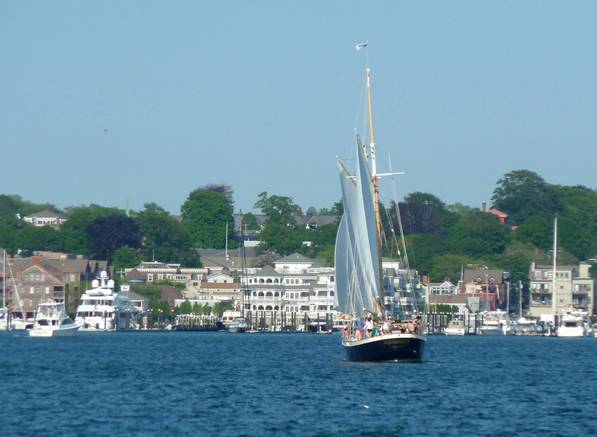
But all in all, the east coast of the USA is an amazing cruising ground.  Rhode Island was interesting; historic Newport calls itself the yachting capital of the world.  For many years, the America's Cup was based here, giving the claim considerable merit.  It's certainly a hive of yachting activity despite harsh winters and a short sailing season.  There's a real buzz ashore as the J-Class yachts Ranger and Valsheda prepare for a regatta, each with around 20 uniformed crew.  The grey-haired owners look preoccupied on their mobiles; fashionable WAGS parade on the quayside.

Croissant American style - about twice the size of its French cousin.

As a summer retreat for the exceptionally wealthy, the island was populated with wonderful 'cottages', enormous mansions not unlike English stately homes, now preserved and open to Joe public.  Here an elderly lady sporting a ring with the biggest diamond Stellie has ever seen professed to be a major benefactor of the Preservation Society of Newport.

Stellie at home in The Breakers, a 70 room summer mansion built for shipping and railroad magnate Cornelius Vanderbilt II.  The Great Gatsby was filmed here.


We enjoyed cycling everywhere and our British 'fold-up' bikes attracted much attention.

The sheltered waters around Rhode Island extend over 40 miles inland, a sailor's paradise.  At Melville, we made arrangements to have our boat slipped later this summer at an attractive rural boatyard.  An ancient railway diner shuttles between here and Newport.

"No Stella, the brake's on the other side..."
Further north in a lovely anchorage off Bristol, we were astonished by a new arrival – a seaplane landed next to Ananda.  The pilot then motored slowly around the bay, visiting a couple of marinas until he found one with piles low enough for him to tie alongside without clipping his wings.  Curiously, no-one seemed to pay him much attention or indeed offered to run him ashore!


As a breakfast treat, we went for the much recommended Hope Diner.  It was traditional diner, just like those that you see in every road movie.  A cast of old boys argued about a player in their local baseball team, the Red Sox.

'They oughta ask for the money back – ya know, lemon law…..'

'Aw, cummon… '

We sat patiently listening to the banter until, prompted by the old boys, the waitress who was busying herself behind the bar grudgingly appeared to serve the newcomers.

'How d'ya like your eggs?'

I wracked my brain for the answer.  It's in those old movies – what was the line? Of course!

'Sunny side up.'

She seemed satisfied with my answer and the meal duly appeared.  The home-baked strawberry muffins were just splendid!

Bristol was also the home of the lendary America's cup designer Nat Herreschoff; his shipyard is now a museum.

Hanging from the ceiling at the Herreschoff museam, this modern-looking catamaran complete with circular cockpit was designed and built over 100 years ago.


Further north still, we anchored in Battleship Cove, Fall River, under the bows of USS Massachusetts.  This WW2 battleship was part of an amazing naval collection that included the destroyer Kennedy , the submarine Lionfish and an East German missile corvette Hiddensee.  Visitors are free to wonder through every nook and cranny of these impressive vessels.


Big Mamie, the 681 foot WW2 battleship Massachusetts, complete with nine 16 inch guns protected by 18 inch thick armour plating.  With a crew of 2,230 men, she saw action in both the Mediterranean and Pacific.

Shell shocked
At Block Island, we were lucky enough to arrive while a 3 day music festival was being held.  Acts, some from quite far afield, performed outdoors for the early evening and then later onstage indoors.  And it was all free, including fresh popcorn!

A stitch in time - patching our ancient mainsail in Block Island

Martha's Vineyard is a charming island, both tasteful and timeless.  No wonder it's the playground of presidents.  The Kennedy's came over regularly from nearby Hyannis on the south of Cape Cod.  It's where Edward Kennedy took a wrong turn at a bridge at Chappaquiddick with disastrous consequences for both Mary Jo Kopechne and his subsequent career.  The Clintons and Obamas are regular visitors.  Carly Simon is a resident; James Taylor has since moved though his family are still here.  His brother, Livingstone, does a concert in a Church in Edgartown every summer.

At Oak Bluffs in the mid 19th Century, religious revivalists and travelling preachers would gather and set up camp in the seaside wilderness.  Their tents were gradually replaced by wooden cottages, gaily painted and highly decorated, the so called gingerbread cottages.  They built a huge tented tabernacle, now a permanent open structure.  Though the religious fervour may have mostly departed, some towns on the island still remain 'dry' - people eating in some restaurants must bring their own wine.

Gingerbread cottages at Oak Bluffs
Hard to leave Martha's Vineyard, but its time to head north.  Next stop, Naushon island…

Sunday, 29 May 2011

Washed up in America

Location: 41 28.81 N 71 19.99 W

It's 10pm local time and the USA coastline is closing fast.

A little too fast, actually, because we don't really want to arrive too soon.  With no moon at the moment, the nights are pretty black and we would prefer an early morning arrival with good light for anchoring.  So we're flying less canvas to slow the boat down, and things are pretty peaceful.  There's a fishing boat in the distance, its working afterdeck lit brightly for safety.  And a coaster overhauls us as it chugs slowly eastwards towards Fall River.  We had called him up earlier as our courses were converging.  'What are your intentions, Sir?'  The captain sounded surprised – had he actually seen us? - but altered course to pass safely behind our stern.

After nearly 5 days at sea, it feels strange to be so close to land.  Looking at the charts, the names of the surrounding places read like an American social history.  To our left is Long Island, with New York just beyond.  To our right there's Martha's Vineyard and Chappaquiddick, then Nantucket with Cape Cod just to its north.  And ahead lies our destination, Newport, Rhode Island.

It's hard to believe we're only a few hours from any of them.  Hopefully we'll visit them all in time, though our cruising itinerary for the next few months is still in its infancy, sort of nascent, err… well, not actually conceived yet.  But that's cruising for you – kind of flexible, you see.  As fickle as the wind, our plans can (and do) change, moulded by weather, the books that we read so avidly on passage, the music we listen to and the friends that we make along the way.  For the cruising fraternity is a sort of floating village, a mobile community of largely like-minded adventurers that is always generous with help and advice.

We're excited to be arriving in America, though not quite sure what to expect.  The navigational charts themselves, furnished as they are with a wealth of detail, offer a hint of what's to come.  Marked on the chart , and all within 10 miles of us, are 'unexploded bomb 1968', 'unexploded depth charge Nov 1960', 'unexploded torpedo 1985',  'unexploded ordinance 1987 and 1992' , 'unexploded bombs Dec 1958' and 'Danger, sulphuric acid'.  Why do we never hear of this sort of thing in the UK?  Do our bombs and torpedoes never fail to explode?  Or is it just that we never get to hear about it?  So it looks like the country we're about to visit is an open society.  Or perhaps just a society prone to litigation?  Anyway, the water is fairly shallow here, about 30 metres, so I hope none of it goes off!

The passage from Bermuda has been pleasant with light conditions.  We left at short notice on hearing that a 'weather window' had just opened, with the promise of fair winds.  This was important for us, as part of the voyage included crossing the Gulf Stream, a tidal stream that runs along the American coastline at over 4 knots.  When the wind blows against the flow, the seas quickly build up to mountainous proportions.  We were lucky, and all was calm.

But as I write, a mist has descended.  Fog!  There's an eerie loom reflected around our navigation lights by the moist air.  Everything is becoming damp to the touch, and I put on a pullover. The fishing boat 'disappears' at a distance of about 2 miles, but soon visibility is only 100 yards, and we watch the radar and AIS closely as we approach this busy port.  We count off the buoys one by one - Narangassett B, Brenton Reef, Butter Ball, each passing close enough to appear out of the mist, sounding a mournful bell or whistle… for whom the bell tolls…

The day brightens, and with the rumble of the anchor chain in the safety of Brenton Bay next to an invisible Fort Adams, we reflect on our journey to the 'New World'.  The visit by a school of Spinner dolphin a few days ago had been spectacular.  After playing in our bow wave for a while some had performed amazing acrobatic leaps and somersaults high into the air, so typical of this breed.

We slowly prepare to go ashore to clear customs.  Once the fog has lifted enough to be able to find our way back to the boat, that is…

Newport scene - once the fog lifted

New York Yacht Club's Newport base - previously the home of John Nicholas Brown of Brown University fame

Tuesday, 24 May 2011

Bermuda - another world

Location: 32 22.73 N 64 40.28 W

Today is Bermuda Day.  Originally Queen Victoria's birthday, this public holiday is big here and marks the start of the summer.  Yes – Bermuda is still an overseas territory of the UK!  A referendum in 1995 supported this status, although the islands have been self-governing since 1968.  So things carry on much as they always have done.  No self-respecting Bermudian goes into the sea before Bermuda Day –'it's too cold, baaiii!' – although we found the temperature perfectly pleasant (23 degrees) yesterday when diving to replace an anode on our propeller.

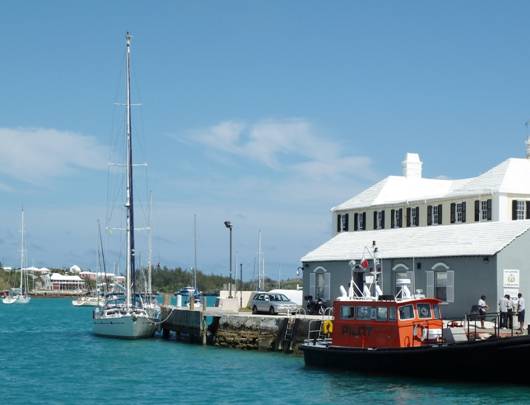
Ananda clears customs at St Georges, Bermuda

Bermuda rigged

There's a parade on in Hamilton, and there's going to be a special yacht race here at St Georges – the local traditional class of Bermuda Fitted Dinghies.  Their crews will certainly be hoping the water is warm enough, as they'll probably end up swimming in it.  For the rules of this historic racing class don't require the same number of crew at both the start and finish.  So if the competition is close towards the finish, the crew literally jump ship and swim home leaving a lighter and hopefully faster boat!

Some balancing act here...
Unstable, ridiculously over-canvassed and with virtually no freeboard, the yachts always appear to be at the point of sinking.  One member of crew has to bail throughout the races.

Last week we visited the tiny Royal Bermuda Yacht Club (RBYC) in Hamilton – a fascinating haven dating back to 1843 and with a collection of historic artefacts that would grace any museum in the world.  There are half models of famous sailing ships, and plaques from visiting ships, including one of only two given by the Royal Yacht Britannia – Prince Phillip had it specially made.  On the walls there are pictures of the Queen visiting shortly after her Coronation and again in 1993 for the club's 150th anniversary.

There's even an RBYC club burgee that had been taken into space in the pocket of astronaut Readdie, a keen visiting racing sailor who later became a leader of NASA. No wonder the club remains popular with the Royals – Prince Edward and Sophie visited only a month ago.  Thanks, Sheree and Bruce (ex-Commodore), for kindly showing us around!

The hospital where I worked as a newly qualified doctor is still there, in Paget.  It's undergoing a huge re-development with fine hurricane-proof windows.   All of this is being financed by a private finance initiative (PFI), sadly much the same as most new hospitals in the UK.  Build now and let your children pay the huge loan charges later.  But we found the old house where I lived, set amidst the beautiful botanical gardens next to the hospital.  Now it's the park office!

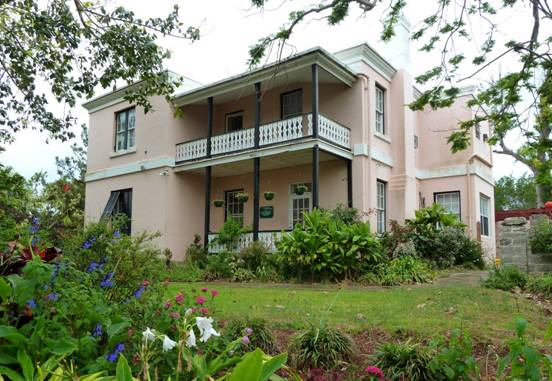
My house (is a very very very fine house...)

Shipwrecks galore

The best way to see Bermuda is on 2 wheels, and our hired scooter allowed us to find areas we had never visited before.  Bermuda is really a series of coral islands interlinked by bridges and with countless protected bays and lagoons.  To the chagrin of mariners of old (and some new), the surrounding coral reefs stretch out to sea in every direction for miles and are littered with shipwrecks.

At Spittal Pond nature reserve we found a rock carved by Portuguese sailors who were shipwrecked here in 1543 (not long after the Spanish explorer Juan de Bermudez originally discovered the islands in 1505).  They apparently built another boat and sailed off again.  It wasn't until 1609 that an English ship headed for Virginia, the Sea Venture, was wrecked here in a hurricane; this time the 150 marooned sailors set up a colony.  They then built 2 ships from scratch and went on to rescue the failing colony of Jamestown in Virginia.  It was an account of this saga that inspired Shakespeare's play The Tempest.  John Rolfe, one of the shipwrecked passengers who was a farmer, went on to marry an Indian princess, Pocahontas, and make Virginia's fortune by cultivating tobacco… but that's another story, to be continued as our travels progress! 

Since then, the islands have welcomed weary sailors over the centuries.  Luckily, our sea journey here was fine.  But Mark Twain was certainly grateful to arrive in 1867 on the Quaker City.  He commented 'Bermuda was a paradise but one had to go through hell to get there'.

Onwards to America

So, all in all, we've had a terrific week here - a real 'blast from the past'.  But now it's time to go.  We can feel the lure of the New World.  We're off to America, land of the free.

Destination (sort of) is Newport, Rhode Island, some 650 miles to the northwest.  We're expecting some calms for the first couple of days so we've taken on more fuel, though with depressions further north, there may be stronger winds to come.  Stellie has stocked up with fresh fruit and vegetables, though not too much meat, as we hear that the US Customs sometimes confiscate stuff.  You'd think they were paid enough to buy their own food, wouldn't you?

No WiFi so we'll post this episode at sea by satellite.  This means small pictures, but no worries, we'll update them when we arrive…done!

Sunday, 15 May 2011

Nowhere, man

Location: 26 51.00 N 64 06.00 W

It's nearly midnight on a moonlit Saturday night and I'm writing this at the chart table of a little boat floating out there somewhere in the middle of nowhere in particular. 

We've been at sea for almost 5 days and nights, sailing a course almost due north from the Virgin islands.  With either very light head winds or no wind at all, we are not going to take any records for speed on this passage.  Looking out from the cockpit, there's little to see from horizon to horizon.  A heavy swell of about 2 metres rolls in towards us , rather less than yesterday, and is a remnant from bad weather further north; a deep depression that is now winging its way across the Atlantic towards Europe and burning itself out in the process.  The moon shines brightly overhead in a clear sky, with a few small clouds ahead of us.  These don't look  threatening, unlike one or two of the dark squalls we had earlier on, suddenly pushing the boat hard over so that we run about reducing sail, only for it all to go calm again 10 minutes later.

But despite having to motor for long periods, the journey so far has been a pleasant one.  The nights are a lot shorter than they were on our Atlantic crossing in January, and somehow feel friendlier when bathed in the bright light of a waxing moon.  Dawn is at about 5am and apparently comes with a fabulous range of colours; reds, oranges, yellows, turquoises and blue (information courtesy of Stella who has been doing the early morning stint, the so called 'graveyard' watch!).  At one stage we stopped the boat to look at something floating in the water.  It was an orange buoy, marked 'underground cable' that had probably been washed into the sea somewhere.  But as we stopped and looked down into 5000 feet of clear  water, we saw a shoal of about 60 silver fish, about 12 inches in length with stubby tails like those on parrot fish.  They seemed curious and stayed close to the boat.


Last night, we spotted a tell-tale water spout astern, then another nearby.  Playing on the surface was a Fin whale, with an asymmetrical white underside to its jaw and tiny dorsal fin placed well back along its narrow body.  It made 4 or 5 shallow rolls over a minute or two with a final steeper arch of its back before disappearing into the deep.  These beautiful creatures are big, second only to the blue whale, and can grow to nearly 90 feet and 76 tons.  Reaching speeds of over 20 knots they could out swim the early whaling boats,  though sadly not the diesel powered Japanese whalers of today.

Alarms galore

In keeping with the usual nautical way of things, we've had our share of technical hitches too on this leg.  Within 24 hours, both engine and generator exhaust alarms went off.

The generator sea water pump impellor had stripped its fins off, and replacing it took a couple of hours of bending over on the cabin sole whilst Stellie tended to the sails in the rolling ocean swell.  But the following day I had to do battle with the mighty main engine impellor too.  The fight was long and hard, taking most of the day, but persistence paid off.  I emerged from the hot engine room battered and bruised from the struggle but victorious!  The massive impellor was replaced, but in the event my diagnosis had been off the mark.  The overheating was in fact due to a blocked strainer in the seawater inlet, and soon sorted by Stellie and me.

As if I needed more to do, the next day the main engine alternator alarm went off. Despite this indicating alternator failure, a play with my multimeter showed this not to be the case, with much relief all round.  Than yet another alarm sounded - an unfamiliar 'chirrup' this time, and only a carbon monoxide alarm with a flat battery. All just too complicated, eh?

Moving on up

Every morning, we try and check into the rum-runners, an informal SSB radio net for cruising yachts.  But as we all stray further apart, reception has been difficult lately and I can only check in by relaying via another boat.  There's also the legendary Herb to try and contact in the afternoon, if I ever get the chance.  Operating from his home in Canada, Herb has won every prestigious award going for his daily weather information service dedicated to yachtsmen making ocean passages, and he has assisted in many emergencies too.  A retired forecaster with formidable knowledge, he continues to practice what has now become his hobby on a voluntary basis.

Yesterday, we were called up on VHF by Dulcinea, a yacht that we could just see in the distance to the west of us.   It was good to chat to the friendly owner and exchange weather information, an understandable obsession for all of us out here on the oceans.  He was on passage from Antigua to Newport via Bermuda in a custom 63 foot yacht, designed for the owner by Bill Dixon.   Dulcinea slowly overhauled us over the course of the afternoon, no doubt helped by a slippery, freshly antifouled hull.  Our own bottom paint, now 2 years old, is slowing us down.  Despite our regular forays with snorkel and scrubbing brush, the hull is becoming so encrusted with weed and molluscs that it is beginning to resemble the hanging gardens of Babylon!  Definitely time for a repaint - maybe in America?

So onwards and upwards we go.  It's less than 300 miles to Bermuda, our next port of call, which should be a sort of homecoming for me.   A long time ago I  worked for a year in King Edward V11 Memorial Hospital, so time to revisit old haunts.  Stellie knows Bermuda well too, as back in in 1979 we sailed there on our first boat Coot, along with our good friend Tim.

But as we head north away from the tropics, the nights are definitely becoming cooler.  Although this comes as a bit of a relief for now, it does mean that at some stage we'll need to start wearing real clothes...

Tuesday, 10 May 2011

Ooh la la!

Location: 18 30.13 N 64 21.77 W

Ooo la la! We could hardly believe our eyes.

In many ways, 'Ananda' is our very own 'Tardis'.  Rather like Dr Who's quirky spaceship, she's quite roomy for just the 2 of us.  Comme dites les Francais, 'L'interieur, c'est beaucoup plus grand que l'exterieur'.  But this time, after just one day's brisk day's sailing north from St Lucia, it really did feel as though we had been transported through both space and time.

Our arrival on the island of Martinique was greeted by Gallic scenes that placed us firmly back in the heart of Europe, and strolling along the Champs Elysee.  We sipped an orangina at a pavement cafe whilst ladies, decked out in the latest Parisian fashions, paraded past boutiques and art galleries.  The smell of fresh croissants wafted from the doors of boulangeries and patisseries.  All that was needed to complete the scene was an onion-seller in a blue and white stripey t-shirt!   

Even the customs and immigration procedures had been bought up to date.  We had grown accustomed to the usual island tedious form filling bureaucracy, a natural inheritance from a largely British colonial past and administered by bored officials dragging it out ad infinitum to justify their existence.  But here on Martinique, the digital age had dawned.  Procedures are rapidly completed by simply filling out an on-line form on a computer housed in a chandlery!  And no charge, either.  Civilisation indeed.

 All this relative affluence is because the island is still effectively administered from France as a quartier.  Historically, Empress Josephine grew up here, on a 200 acre, 150 slave estate.  And rather cheekily, in 1804 the British captured Diamond Rock, a steep pinnacle off the south coast of Martinique, and commissioned it as a ship.  This meant they could take pot-shots at any approaching French ships – a rather nasty surprise for them.  Napoleon was incensed – all this and at the home of his beloved Josephine, too!   He ordered Admiral Villeneuve to go and re-capture the rock and, whilst he was at it, to destroy Horatio Nelson. Villeneuve did indeed manage to recapture the rock – based on faulty intelligence, Nelson had gone on a wild goose chase to Trinidad.  But Villeneuve was in disgrace for not destroying the British fleet, and preferring death to dishonour, he later put his ill prepared fleet to sea to meet Nelson at Trafalgar.  Ironically, he survived though Nelson didn't.

The next day, we move from the capital, Fort de France, to Anse Mitan, a quieter anchorage in the same enormous natural harbour with a fort on its headland, now overgrown by nature.

In contrast to Martinique, Dominica is undeveloped and poor, though with a natural beauty.  The water was deep right to the land's edge, and we rented a mooring for the night from Dwayne, a friendly and polite boat boy - a real ambassador for Dominica, said Stella – and handed over $30 EC with a bottle of beer for good measure.  The following morning we were awoken by an angry fisherman.  'What are you doing on my mooring, man?'  Oh dear, just going…

By now we were running out of croissants and ready for another taste of France.  So the next stop on our lightening Caribbean tour was the Isles des Saintes, off Guadeloupe.  Funny thing, the descriptions at the museum in Fort Napoleon (facing Fort Josephine on the opposite hillside – now sadly in ruins) are not very complimentary about the English!  We savour the lovely holiday atmosphere, and enjoy our stay.

But we are awoken at 1am by a huge bang.  A 35 foot yacht, Saudade has dragged its anchor and crashed into us.  By torchlight there is some damage to our hull and wooden toerail.  The French couple onboard are clueless, doing little to help, and make no apology.  Furthermore, the captain, a Monsieur Francois Marie Joseph de la Vigne Sainte-Suzanne, is drunk; de la Vigne both by name and by deed.  Ignoring our shouts, he motors off into the darkness.  Hurriedly, we launch the dinghy and give chase in the dark.  By now he is halfway across the bay, but we catch hold of his dinghy and demand that he stops.  He refuses and carries on motoring with us in tow, refusing our demands for insurance details.  Eventually his wife relents and gives us a business card (a rum factory on Martinique) though still no insurance details.  Frustrated, we cast off our dinghy into a moonless night on quite big seas to search for our own yacht, by now miles away and in another bay.

I hope you're reading this, M de la Vigne…

It's a windy sail to Guadeloupe, and 40 knot squalls take their toll on the bimini cover, which needs repairing.  But Deshaies is a lovely anchorage, with a beautiful river flowing into the bay.  With wet weather, we attend to jobs and I service the generator.  Then we walk and climb through the rainforest and up the riverbed for miles, bathing in the rock pools to cool off.  Bats fly to and fro across the water, and we have it all to ourselves.

The beautiful river at Deshaies in Guadeloupe - a great climb through the rockpools

Guadeloupe is unspoilt, beautiful and civilised.  We even have croissants delivered to the boat for breakfast – merci, Harold! – and enjoy them very early the next day watching the Royal wedding live in the surreal environment of a yacht at anchor in this remote tropical bay!

After the Royal kiss on the balcony, on comes the windlass and we're off to Antigua to catch the end of Race Week and sailing at over 9 knots.  Things are really humming here, the mood is festive and anchored in Nelson's Dockyard, we can admire the world's finest yachts, both here and in nearby Falmouth harbour.

Valsheda, a perfectly restored J-class yacht moored next to her support ship Bystander


Windrose of Amsterdam looks magnificent, and both Lady B and Eros are there too.  But by far and away the most impressive sight was the arrival of Maltese Falcon.  Huge, stylish and distinctive, she certainly turns heads with her rotating clipper rig - square sails set on 3 giant carbon fibre masts.  Built originally for Tom Perkins, the Silicon Valley tycoon and venture capitalist, she was sold in July 2009 for a reputed £60M.

The magnificent Maltese Falcon


As she completed mooring up, we walked alongside.

'Nice boat!' I shouted up to the blonde lady standing on the side deck.

In retrospect, I suppose that calling a 289 foot ship, one of the largest privately owned sailing yachts in the world, a 'boat' was not my most sensible choice of words, and so the new lady owner of Maltese Falcon, Elena Ambrosiadou, was certainly entitled to give me the look of disdain that I received.

On parade in English harbour

This yacht, moored in English Harbour, has obviously been well fitted out with jungle cruising in mind.


The sail to St Maarten, an island that is half Dutch and half French, was a night passage, and the tone for the journey was set by two large whales, at least 30 feet long, that surfaced about 60 feet off our starboard bow, their waterspouts blowing high into the air.

We passed St Barts in darkness to anchor in Philipsburg at 6am.  Later that day, we sailed to Simpson's Bay, a haven for yachtsmen where you can buy or fix almost anything.  Here, it's a matter of pride for superyacht owners to take their craft through a narrow passage with a lifting bridge into a huge natural lagoon.  Moored up in there was Mirabella V, the largest sloop in the world.  It's hard to get a perspective on her lofty mast, the biggest ever built at twice the height of Nelson's column, and we enjoyed supper at a waterside restaurant seated under her stern.

View of St Maarten from Fort Louis.  The mast on the horizon, right side, belongs to Mirabella.  Saba, rising to 3000 feet, can be seen in the distance.
Dinghies are the most convenient form of transport in the lagoon.  We zoomed around from chandlery to chandlery, stocking up with spares and motored over to the French quarter to soak up the different culture.

Next stop was the British Virgin Islands.  With a night time arrival we navigated carefully through Virgin Sound, the appropriately named passage between Richard Branson's Necker Island and Virgin Gorda, to anchor in North Sound, a large and protected natural harbour.  A hired 4-wheel drive car enabled us to explore the island further with its steep roads.

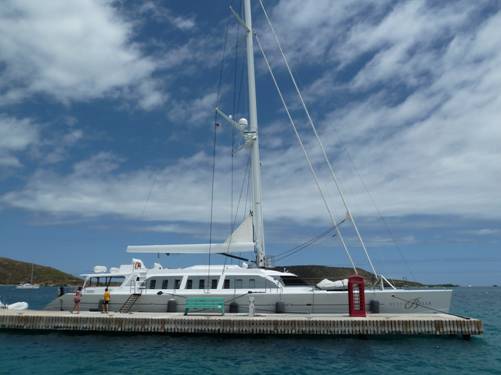
Richard Branson's yacht Necker Belle.  The phone box off the starboard bow isn't much help in keeping him in touch with his business interests, now that it's been converted into a shower!

Stellie sews a new 'soft door' for Ananda's companionway
We're now heading north faster than the sun.  Come a favourable forecast, we'll soon be heading off to Bermuda, some 850 miles to the north of the Virgins.

And at this rate, we'll need to start wearing some warmer clothes.

Wednesday, 20 April 2011

Looking for Noli

Location: 13 50.57 N 61 03.80 W

Our interlude in the UK went by in a flash. 

Well done, Peter!
It was wonderful to catch up with family and friends and we were proud to attend son Peter's MA graduation at Cambridge University.  Even the weather was warm and settled, nourishing the spring flowers and waking up the countryside.

*    *    *    *    *

Back on board, we found it really hard to leave Le Phare Bleu.  The ship was overwhelmed with tentacles of mangrove wrapping themselves around the ship and tying down our arms and legs too – in short, a very bad case of port rot indeed.  But leave we eventually did, and dragging ourselves away, we sailed around the coast to St Georges.  Fortuitously delayed here for 24 hrs by poor visibility from heavy rain, we were delighted by the arrival of the catamaran Saba, belonging to our German friends Daniel and Silkae, with their delightful daughters Lenna and Anna.  We hadn't seen them since the Canaries, and it was good to hear all was well with them despite a catalogue of problems with their new, French built boat.  Heading south, they are aiming for Panama and the Pacific, an adventurous enough trip even without two children under the age of 5!

The next day, sailing north in the lee of the island, we were pleased to cross paths with Paul on Stardust, an Oyster 56, on passage from Barbados to join the Oyster Regatta.  We were sorry to miss this great social event, held in Grenada this year, but with such a late Atlantic crossing we needed to be further north if we were to see more of the Caribbean before the start of the hurricane season.

So onwards we sailed, pushing hard against the headwinds and west-going current towards Isle de Ronde.  Our route took us close to Kick 'em Jenny, an active underwater volcano with a 1.5 km exclusion zone around it.

Diamond Island, near the underwater volcano


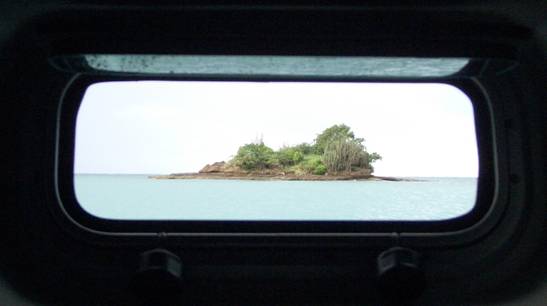
The volcano last erupted in both 1988 and 1989, and it is thought the next eruption will form a new island.  We anchored for lunch only 2 miles away at the uninhabited Isle de Ronde, and were much relieved that the volcano slumbered on.  Apart from a pair of pelicans roosting in an old fishing boat nearby, we were the only occupants of the bay, and we enjoyed a good variety of corals and colourful tropical fish whilst snorkelling off the reefs at the head of the island, no doubt due to their remote location.

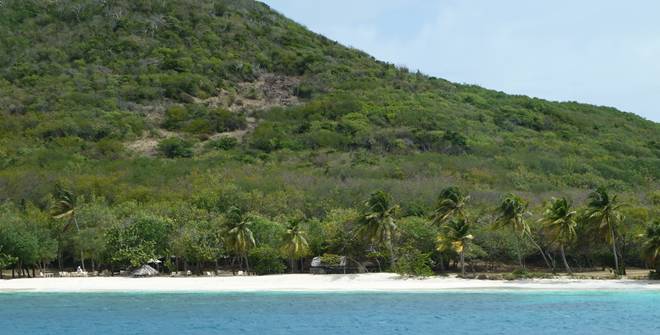
Our next stop was at Sandy Island, a tiny coral island with perfect white sand, though now with less vegetation since the hurricane Lenny.  We anchored here for the night, and after a morning swim we made a long dinghy journey to Carriacou for provisions and customs clearance.   This island is friendly, charming and relaxed.  With far less development than its neighbour, it looks pretty much like the Grenada we remember from 32 years ago.

A short sail northwards again, and we anchor behind a reef at Petit St Vincent, a pretty island that is now an exclusive resort where the guests stay in remote stone cottages, each equipped with a flagpole to summon room service!  The hotel was built by two ex-pilots from the US Air Force who sold up and sailed to the Caribbean in an old wooden yacht.  They chartered, and it was one of their charter guests who thought it would be fun to buy an island and build a hotel.  The hotel is still owned by the wife of one of the pilots.

Petit St Vincent


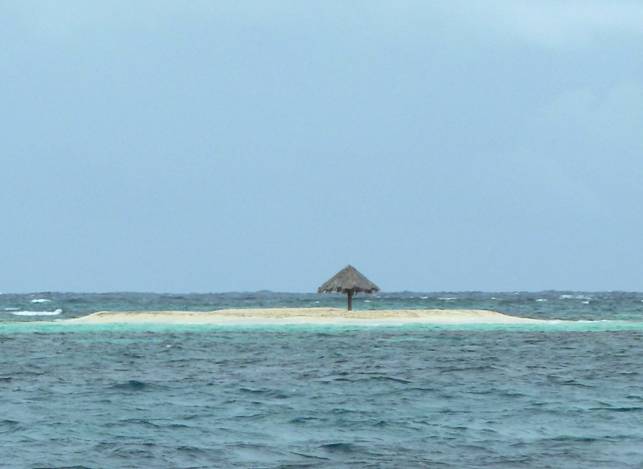
The sail northwards from Petit St Vincent took us through a narrow pass in the reef between two tiny sand cays, Mopion ('crab louse') and Pinese ('bed bug').  No doubt these islands were more than a minor irritation to those unfortunate sailors who were wrecked on this shoal in the days before accurate satellite navigation.

Mopion.  Not much to do here...

The attractive anchorage at Clifton Harbour, Union Island, is tucked between two reefs, and is justifiably popular, especially with charter boats.  With deteriorating weather, the wind and rain blew hard through the night.  Thankfully our anchor, dug in hard against a rock, held fast.  But our neighbours were not so fortunate.  As the wind got up to a howl and the boats danced around each other, there was lots of shouting as a French Beneteau 43 with a crew of 3 older men struggled made several attempts to re anchor in the dark, their torches fading rapidly. By morning they had managed to moor up just behind us, but the skipper was still not happy.  Despite the absence of his two crew members who had escaped ashore in the dinghy, the skipper decided he was going to have another go.  The local 'boat boys',   who offer their services - mooring buoys (sometimes dodgy deals), ice, collection of rubbish etc. - got involved, and one climbed aboard, so there was a lot more shouting especially as the skipper was motoring forward over the anchor chain and the boat boy who was supposed to be pulling up the anchor was busy on his mobile phone!  The crew eventually did return to find their boat gone, and looking a little perplexed motored off in their dinghy to search the anchorage.

The following day, we sailed around the windward side of Union Island and past its short airstrip perched on an outcrop of rock.  With hills to skirt on the landing approach, Stella and I mused over how difficult it must be for planes to land there.  It was then that we noticed the remains of a small passenger plane at the side of the runway!

Happy landings, Union Island style.  Safer by boat, I think...


Onwards, up the lee of Mayreau, and then we sailed past the huge sailing cruise-liner Club Med 2 and into the Tobago cays, a marine national park set inside a protective reef.

Club Med 2 - a different kind of sailing experience!

Anchored off Boradel island, the variety of marine life was amazing and swimming with green turtles in their natural habitat was just wonderful.  The following morning, Walter, a local 'boat boy' (grandfather?) bought over some bread and a banana loaf from the mainland, freshly cooked by his wife.  With 3000 miles of Atlantic Ocean stretching before us, it felt strange to be anchored with only a reef to protect us from the open sea!

Our next stop is a tiny deserted island called Petit Nevis.  When we last called here on our first boat 'Coot' some 33 years ago, we found many huge old bones, remnants of the island's past history as a whaling station.  Now it has been cleared up, but plans to develop the island have come to naught and it remains a peaceful place to hang out.  The only other boat in the anchorage, the Canadian motor vessel 'Tasman', kindly offered us some fish.  The blue marlin they had caught was over 8 feet long – rather a lot to eat on your own!

Petit Nevis
Where is Noli?

Bequia still has an easy-going and yacht friendly atmosphere.  Admiralty bay, a protected natural harbour, remains unspoilt and is a hive of activity.  We're on a quest to find Noli Simmons, a friend from long ago, and we tie alongside a fishing boat to ask where he might be found. 

The fishing boat has just arrived after 4 days at sea, and our conversation is interrupted by the crew blowing a conch shell 'horn' to announce their arrival!  We buy some Dorado from their huge catch, which they fillet for us on the shore and rinse in the sea.

Com' buy me fish man!
Tracked down at his favourite drinking haunt, Frangipani's, Noli is great company. The last time we drank at this bar, I was a moustachioed hippy playing my guitar under the frangipani trees.  But Noli still remembers me.  In those days he was building a 70 foot wooden boat right next to the restaurant, using traditional materials and techniques.  The frames were of solid local cedar, each tree chosen for a specific part of the boat, and it was planked with silver Bali imported from Guyana.  The owner to be?  None other than Bob Dylan!

Noli - 32 years on

As well as building and sailing traditional sailing yachts, Noli is a trained architect and built his own house too.  He still lives on Bequia, building another house whilst researching local history.  He remains a great fan of Isambard Kingdom Brunel.

Another lounge lizard at the Frangipani bar - this one is cannibalistic!
And Dylan's boat?  Sadly, it had an unhappy ending.  Not long after completion it was lost on a reef - a complete write-off.

It's only 14 miles to the next island, St Vincent, and we anchor in a tiny deserted bay called Petit Byahaut, which we initially have to ourselves.  Just down the coast from the bay where 'Pirates of the Caribbean' was filmed, this bay is unspoilt with beautiful coral reefs which we dive on.  We take a dinghy ride around the headland to a large and dark cave.  I swim to the entrance, and inside I can see hundred of large bats flying around, the size of seagulls!  There's a 30 foot long dark tunnel that apparently leads out through the cave into a rock fissure about 30 foot high and 40 foot deep, but it's just too spooky for me to attempt to swim through it.  Chicken, or what?

Part of the film set for the film "Pirates of the Caribbean" in Wallilabou Bay, St Vincent, now sadly in disrepair.  No sign of Johnny Depp.

The sail to St Lucia was fast and comfortable with enough wind until we sailed into the lee of the Pitons – two mountains rising 2500 feet straight out of the sea.  Here, the water was so deep that we picked up a mooring and tied the stern of our boat to a tree.

The Pitons, St Lucia.  We moored at the base of Petit Piton, the one to the left of the picture.
*    *    *    *   *
Just give us the banana and sod off...

Sunday, 10 April 2011

Cocoa, rum and spice

Location: 12 00.20 N 61 43.45 W

"Ahoy there skipper!"

As we pulled into Prickly Bay, Grenada our friends Tim and Barbara, on holiday from the UK, were waiting for us on the shore!  After clearing customs, we welcomed them on board with 'Ananda juice' – a spicy cocktail with ginger, honey and lemon (not to mention the ubiquitous rum, of course).

Prickly Bay


It's about 95 miles to Grenada from Tobago, our last port of call, and too far for a day sail.  So, the previous day, we had enjoyed a last minute swim off the nearby reef then an early supper and a sleep before weighing anchor at midnight.  The night voyage was a pleasant one, a close reach in moderate seas and with excellent visibility.  An obliging passenger ship, The Oceanic, with 'peace boat' painted in large letters on its topsides, altered course for us.  As we reached along the south coast of Grenada at dawn, Stellie baked banana muffins.

Grenada is known as the 'spice island', a well deserved description.  Despite the terrible devastation wrought by hurricane Ivan in 2004, the interior of this volcanic island is like a giant botanical garden with exotic spice and fruit trees in abundance.  Almost anywhere, if you stop at the side of the road, you are likely to find nutmeg, cocoa, bananas, avocado, papaya, lime, pineapple, cinnamon, cloves and ginger all growing together.


The rain forest is slowly recovering, and there are lush green mountains with waterfalls.

The fish arrive at De Big Fish Bar, Prickly Bay
 
Grenadian school and friendly children
Rum…

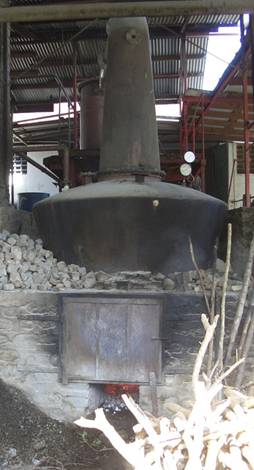
At the River Antoine Rum factory, a strong (73%) white rum is made in much the same way as it ever was in 1780.  A giant waterwheel powers the mill that crushes the sugar cane, and the dried residue of the cane burnt to heat the juice in giant cast iron bowls.  The juice is scooped into them with giant wooden ladles and then fermented.  The copper still is heated by burning wood, and the rum (about 1000 bottles per week - for domestic consumption only) is bottled by hand.

The waterwheel - no frills, ecological too.

Cane mashin' machine
 Driven by the water wheel, the cane is crushed and the juice flows into a wooden trough (by the worker in the blue hat, who is scooping out any floating residue) and then into a pipe that leads to a large vat.  The cane residue is then heaped into the rail cart that then runs along a track.  It is then unloaded manually and then spread out to dry in the sunshine.

Hot stuff


Bottling it all up
 Taking only about 2 weeks from start to finish, the whole process is virtually independent of electricity, and so production wasn't even halted for the hurricane!  Was this one of the reasons why the Grenadians managed to cope with Ivan's havoc and destruction as well as they did?

..cocoa…

At the cocoa station, the beans are removed from the pods and left to ferment for a couple of days before being laid out in the sun to dry.  Ladies wearing wellington boots trudged through the trays each day to turn them over and ensure they dried completely.  If desired, the beans are then polished in a large drum using a belt driven electric fan before being weighed into sacs and sent off for export or to the Grenada Chocolate Factory.  The empty pods are used as mulch around crops, so nothing is wasted.

The cocoa trays are built on rails so they can be pushed under shelter when it rains

...and nutmeg!

Before the hurricane, Grenada was the world's second largest nutmeg producer.  But now that so many of these shallow rooted trees have been lost, Grenada has been overtaken by other countries.  It was sad to see the nutmeg co-operative plant at Grenville only running at a fraction of its former capacity and employing only 16 people instead of over 100 in better days.


One hopes that the intensive replanting of the past few years will (literally!) bear fruit and improve matters.  But we saw untended nutmeg trees, with the fruit going uncollected, when we toured the island, making us wonder whether there may be other, more economic reasons why production has declined.

The south coast of the island is indented with beautiful sheltered inlets where we spent peaceful nights at anchor amongst the mangroves, watching the amazing birdlife.  An osprey dived to catch a fish off our stern, and magnificent frigate birds with their forked tails and white breasts circled overhead.  Cranes hid amongst the mangroves, well camouflaged with their long legs.

Some of the inlets had been tastefully developed, with exclusive waterside resorts including docking facilities for yachts.  Tim and Barbara were based at True Blue resort which had just opened, with bespoke metal artwork of turtles and fish and a wonderfully haphazard waterside restaurant, the 'Dodgy Dock'.

View from aft cabin, True Blue Bay
But we loved Le Phare Bleu, where the office, clubhouse and washing facilities were incorporated into an old Swedish lightship, as well as an exclusive restaurant on its upper decks.  Built in 1905, the Västra Banken stood guard over the bank of its namesake until, bought by the owner of the resort, it was completely restored in Germany.  The ship still has its original engine – apparently in working order, though rather smoky! 


As temporary berth holders we also had use of the resort's swimming pool and catamaran dinghy, but with a flight home booked, there was little time to relax.  We prepared Ananda for a spell on her own, removing a deck fitting for modification in the UK, mooring her up securely and flushing preservative through the water maker.

*    *    *    *   *