Wednesday, 20 April 2011

Looking for Noli

Location: 13 50.57 N 61 03.80 W

Our interlude in the UK went by in a flash. 

Well done, Peter!
It was wonderful to catch up with family and friends and we were proud to attend son Peter's MA graduation at Cambridge University.  Even the weather was warm and settled, nourishing the spring flowers and waking up the countryside.

*    *    *    *    *

Back on board, we found it really hard to leave Le Phare Bleu.  The ship was overwhelmed with tentacles of mangrove wrapping themselves around the ship and tying down our arms and legs too – in short, a very bad case of port rot indeed.  But leave we eventually did, and dragging ourselves away, we sailed around the coast to St Georges.  Fortuitously delayed here for 24 hrs by poor visibility from heavy rain, we were delighted by the arrival of the catamaran Saba, belonging to our German friends Daniel and Silkae, with their delightful daughters Lenna and Anna.  We hadn't seen them since the Canaries, and it was good to hear all was well with them despite a catalogue of problems with their new, French built boat.  Heading south, they are aiming for Panama and the Pacific, an adventurous enough trip even without two children under the age of 5!

The next day, sailing north in the lee of the island, we were pleased to cross paths with Paul on Stardust, an Oyster 56, on passage from Barbados to join the Oyster Regatta.  We were sorry to miss this great social event, held in Grenada this year, but with such a late Atlantic crossing we needed to be further north if we were to see more of the Caribbean before the start of the hurricane season.

So onwards we sailed, pushing hard against the headwinds and west-going current towards Isle de Ronde.  Our route took us close to Kick 'em Jenny, an active underwater volcano with a 1.5 km exclusion zone around it.

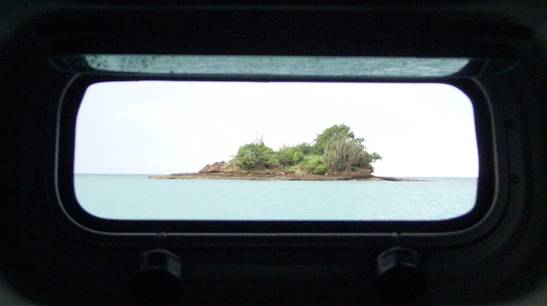
Diamond Island, near the underwater volcano


The volcano last erupted in both 1988 and 1989, and it is thought the next eruption will form a new island.  We anchored for lunch only 2 miles away at the uninhabited Isle de Ronde, and were much relieved that the volcano slumbered on.  Apart from a pair of pelicans roosting in an old fishing boat nearby, we were the only occupants of the bay, and we enjoyed a good variety of corals and colourful tropical fish whilst snorkelling off the reefs at the head of the island, no doubt due to their remote location.

Our next stop was at Sandy Island, a tiny coral island with perfect white sand, though now with less vegetation since the hurricane Lenny.  We anchored here for the night, and after a morning swim we made a long dinghy journey to Carriacou for provisions and customs clearance.   This island is friendly, charming and relaxed.  With far less development than its neighbour, it looks pretty much like the Grenada we remember from 32 years ago.

A short sail northwards again, and we anchor behind a reef at Petit St Vincent, a pretty island that is now an exclusive resort where the guests stay in remote stone cottages, each equipped with a flagpole to summon room service!  The hotel was built by two ex-pilots from the US Air Force who sold up and sailed to the Caribbean in an old wooden yacht.  They chartered, and it was one of their charter guests who thought it would be fun to buy an island and build a hotel.  The hotel is still owned by the wife of one of the pilots.
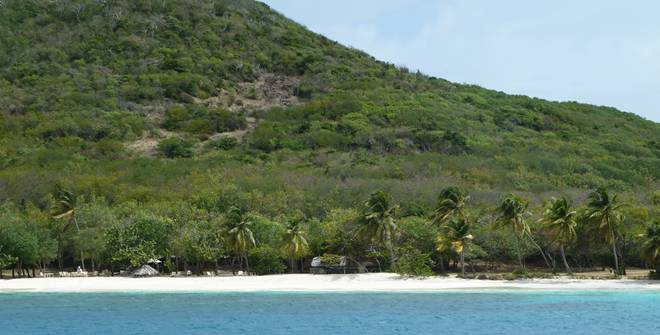
Petit St Vincent


The sail northwards from Petit St Vincent took us through a narrow pass in the reef between two tiny sand cays, Mopion ('crab louse') and Pinese ('bed bug').  No doubt these islands were more than a minor irritation to those unfortunate sailors who were wrecked on this shoal in the days before accurate satellite navigation.
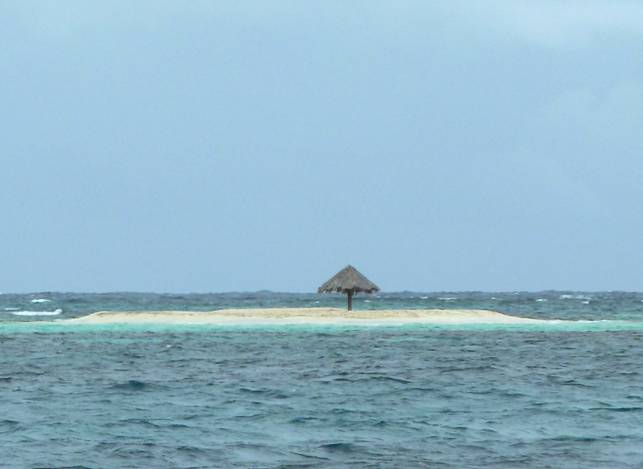
Mopion.  Not much to do here...

The attractive anchorage at Clifton Harbour, Union Island, is tucked between two reefs, and is justifiably popular, especially with charter boats.  With deteriorating weather, the wind and rain blew hard through the night.  Thankfully our anchor, dug in hard against a rock, held fast.  But our neighbours were not so fortunate.  As the wind got up to a howl and the boats danced around each other, there was lots of shouting as a French Beneteau 43 with a crew of 3 older men struggled made several attempts to re anchor in the dark, their torches fading rapidly. By morning they had managed to moor up just behind us, but the skipper was still not happy.  Despite the absence of his two crew members who had escaped ashore in the dinghy, the skipper decided he was going to have another go.  The local 'boat boys',   who offer their services - mooring buoys (sometimes dodgy deals), ice, collection of rubbish etc. - got involved, and one climbed aboard, so there was a lot more shouting especially as the skipper was motoring forward over the anchor chain and the boat boy who was supposed to be pulling up the anchor was busy on his mobile phone!  The crew eventually did return to find their boat gone, and looking a little perplexed motored off in their dinghy to search the anchorage.

The following day, we sailed around the windward side of Union Island and past its short airstrip perched on an outcrop of rock.  With hills to skirt on the landing approach, Stella and I mused over how difficult it must be for planes to land there.  It was then that we noticed the remains of a small passenger plane at the side of the runway!

Happy landings, Union Island style.  Safer by boat, I think...


Onwards, up the lee of Mayreau, and then we sailed past the huge sailing cruise-liner Club Med 2 and into the Tobago cays, a marine national park set inside a protective reef.

Club Med 2 - a different kind of sailing experience!

Anchored off Boradel island, the variety of marine life was amazing and swimming with green turtles in their natural habitat was just wonderful.  The following morning, Walter, a local 'boat boy' (grandfather?) bought over some bread and a banana loaf from the mainland, freshly cooked by his wife.  With 3000 miles of Atlantic Ocean stretching before us, it felt strange to be anchored with only a reef to protect us from the open sea!

Our next stop is a tiny deserted island called Petit Nevis.  When we last called here on our first boat 'Coot' some 33 years ago, we found many huge old bones, remnants of the island's past history as a whaling station.  Now it has been cleared up, but plans to develop the island have come to naught and it remains a peaceful place to hang out.  The only other boat in the anchorage, the Canadian motor vessel 'Tasman', kindly offered us some fish.  The blue marlin they had caught was over 8 feet long – rather a lot to eat on your own!

Petit Nevis
Where is Noli?

Bequia still has an easy-going and yacht friendly atmosphere.  Admiralty bay, a protected natural harbour, remains unspoilt and is a hive of activity.  We're on a quest to find Noli Simmons, a friend from long ago, and we tie alongside a fishing boat to ask where he might be found. 

The fishing boat has just arrived after 4 days at sea, and our conversation is interrupted by the crew blowing a conch shell 'horn' to announce their arrival!  We buy some Dorado from their huge catch, which they fillet for us on the shore and rinse in the sea.

Com' buy me fish man!
Tracked down at his favourite drinking haunt, Frangipani's, Noli is great company. The last time we drank at this bar, I was a moustachioed hippy playing my guitar under the frangipani trees.  But Noli still remembers me.  In those days he was building a 70 foot wooden boat right next to the restaurant, using traditional materials and techniques.  The frames were of solid local cedar, each tree chosen for a specific part of the boat, and it was planked with silver Bali imported from Guyana.  The owner to be?  None other than Bob Dylan!

Noli - 32 years on

As well as building and sailing traditional sailing yachts, Noli is a trained architect and built his own house too.  He still lives on Bequia, building another house whilst researching local history.  He remains a great fan of Isambard Kingdom Brunel.

Another lounge lizard at the Frangipani bar - this one is cannibalistic!
And Dylan's boat?  Sadly, it had an unhappy ending.  Not long after completion it was lost on a reef - a complete write-off.

It's only 14 miles to the next island, St Vincent, and we anchor in a tiny deserted bay called Petit Byahaut, which we initially have to ourselves.  Just down the coast from the bay where 'Pirates of the Caribbean' was filmed, this bay is unspoilt with beautiful coral reefs which we dive on.  We take a dinghy ride around the headland to a large and dark cave.  I swim to the entrance, and inside I can see hundred of large bats flying around, the size of seagulls!  There's a 30 foot long dark tunnel that apparently leads out through the cave into a rock fissure about 30 foot high and 40 foot deep, but it's just too spooky for me to attempt to swim through it.  Chicken, or what?

Part of the film set for the film "Pirates of the Caribbean" in Wallilabou Bay, St Vincent, now sadly in disrepair.  No sign of Johnny Depp.

The sail to St Lucia was fast and comfortable with enough wind until we sailed into the lee of the Pitons – two mountains rising 2500 feet straight out of the sea.  Here, the water was so deep that we picked up a mooring and tied the stern of our boat to a tree.

The Pitons, St Lucia.  We moored at the base of Petit Piton, the one to the left of the picture.
*    *    *    *   *
Just give us the banana and sod off...

Sunday, 10 April 2011

Cocoa, rum and spice

Location: 12 00.20 N 61 43.45 W

"Ahoy there skipper!"

As we pulled into Prickly Bay, Grenada our friends Tim and Barbara, on holiday from the UK, were waiting for us on the shore!  After clearing customs, we welcomed them on board with 'Ananda juice' – a spicy cocktail with ginger, honey and lemon (not to mention the ubiquitous rum, of course).

Prickly Bay


It's about 95 miles to Grenada from Tobago, our last port of call, and too far for a day sail.  So, the previous day, we had enjoyed a last minute swim off the nearby reef then an early supper and a sleep before weighing anchor at midnight.  The night voyage was a pleasant one, a close reach in moderate seas and with excellent visibility.  An obliging passenger ship, The Oceanic, with 'peace boat' painted in large letters on its topsides, altered course for us.  As we reached along the south coast of Grenada at dawn, Stellie baked banana muffins.

Grenada is known as the 'spice island', a well deserved description.  Despite the terrible devastation wrought by hurricane Ivan in 2004, the interior of this volcanic island is like a giant botanical garden with exotic spice and fruit trees in abundance.  Almost anywhere, if you stop at the side of the road, you are likely to find nutmeg, cocoa, bananas, avocado, papaya, lime, pineapple, cinnamon, cloves and ginger all growing together.


The rain forest is slowly recovering, and there are lush green mountains with waterfalls.

The fish arrive at De Big Fish Bar, Prickly Bay
 
Grenadian school and friendly children
Rum…

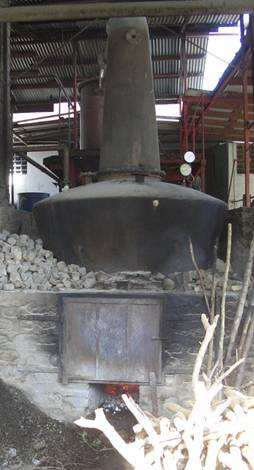
At the River Antoine Rum factory, a strong (73%) white rum is made in much the same way as it ever was in 1780.  A giant waterwheel powers the mill that crushes the sugar cane, and the dried residue of the cane burnt to heat the juice in giant cast iron bowls.  The juice is scooped into them with giant wooden ladles and then fermented.  The copper still is heated by burning wood, and the rum (about 1000 bottles per week - for domestic consumption only) is bottled by hand.

The waterwheel - no frills, ecological too.

Cane mashin' machine
 Driven by the water wheel, the cane is crushed and the juice flows into a wooden trough (by the worker in the blue hat, who is scooping out any floating residue) and then into a pipe that leads to a large vat.  The cane residue is then heaped into the rail cart that then runs along a track.  It is then unloaded manually and then spread out to dry in the sunshine.

Hot stuff


Bottling it all up
 Taking only about 2 weeks from start to finish, the whole process is virtually independent of electricity, and so production wasn't even halted for the hurricane!  Was this one of the reasons why the Grenadians managed to cope with Ivan's havoc and destruction as well as they did?

..cocoa…

At the cocoa station, the beans are removed from the pods and left to ferment for a couple of days before being laid out in the sun to dry.  Ladies wearing wellington boots trudged through the trays each day to turn them over and ensure they dried completely.  If desired, the beans are then polished in a large drum using a belt driven electric fan before being weighed into sacs and sent off for export or to the Grenada Chocolate Factory.  The empty pods are used as mulch around crops, so nothing is wasted.

The cocoa trays are built on rails so they can be pushed under shelter when it rains

...and nutmeg!

Before the hurricane, Grenada was the world's second largest nutmeg producer.  But now that so many of these shallow rooted trees have been lost, Grenada has been overtaken by other countries.  It was sad to see the nutmeg co-operative plant at Grenville only running at a fraction of its former capacity and employing only 16 people instead of over 100 in better days.


One hopes that the intensive replanting of the past few years will (literally!) bear fruit and improve matters.  But we saw untended nutmeg trees, with the fruit going uncollected, when we toured the island, making us wonder whether there may be other, more economic reasons why production has declined.

The south coast of the island is indented with beautiful sheltered inlets where we spent peaceful nights at anchor amongst the mangroves, watching the amazing birdlife.  An osprey dived to catch a fish off our stern, and magnificent frigate birds with their forked tails and white breasts circled overhead.  Cranes hid amongst the mangroves, well camouflaged with their long legs.

Some of the inlets had been tastefully developed, with exclusive waterside resorts including docking facilities for yachts.  Tim and Barbara were based at True Blue resort which had just opened, with bespoke metal artwork of turtles and fish and a wonderfully haphazard waterside restaurant, the 'Dodgy Dock'.

View from aft cabin, True Blue Bay
But we loved Le Phare Bleu, where the office, clubhouse and washing facilities were incorporated into an old Swedish lightship, as well as an exclusive restaurant on its upper decks.  Built in 1905, the Västra Banken stood guard over the bank of its namesake until, bought by the owner of the resort, it was completely restored in Germany.  The ship still has its original engine – apparently in working order, though rather smoky! 


As temporary berth holders we also had use of the resort's swimming pool and catamaran dinghy, but with a flight home booked, there was little time to relax.  We prepared Ananda for a spell on her own, removing a deck fitting for modification in the UK, mooring her up securely and flushing preservative through the water maker.

*    *    *    *   *

Sunday, 27 February 2011

Barbados and Tobago

Location: 11 09.51 N 60 50.53 W

Barbados is a friendly, orderly and relatively affluent country.  This is partly because of where it's situated, stuck on its own out to the east of the other Caribbean islands.  This position made it hard to reach for the Square-rigged sailing ships of old, which were driven back by the prevailing trade winds.  And so the country managed to keep out of the frequent battles between the French, British, Dutch and Courlanders (now part of Latvia) that other islands endured.  Barbados stayed under British rule for over 300 years, although now it is an independent and stable parliamentary democracy.

Anchored at Port St Charles (photo courtesy of Tim Bateman)

Our time at Port St Charles was spent in a social whirl, enjoying incredible hospitality from so many new friends, and sampling that vital by-product of the islands early sugar industry – Mount Gay rum.  Having made it here under our own steam, friends were kind enough to make a fuss of us, although our achievements across the Atlantic were soon put into perspective by the arrival of 2 rowing boats!

Shortly after landfall on a nearby beach, Team Hallin is towed past Ananda
First to arrive was Team Hallin with a new world record time of only 32 days, only to lose the record the very next day to Sara G with a corrected time of 12 hours 12 minutes less!  Having at least an inkling of what they had all been through, we welcomed them ashore and chatted with the crews at the celebrations.  'Not the sort of thing one should be doing too often, I suppose', said Rob (the Irish rower in the dark T-shirt on the far left of the picture).

The crew of Sara G, arriving in fine fettle.
Such a great time, so many kind people to thank; where to begin? Thanks Paul, well, for everything, really.  Thanks too, Moira, Tim, Tony, Betty, John and Sandy for welcoming us into the fun, and Peter for your fascinating tour of the island.  There's Eloisa at Oyster, for coming up trumps with a new furling motor for the mast and Andrew from BOYSS who delivered it only the day after we arrived.  And there's Jeremy and Jason, skipper (Charter skipper of the year too!) and engineer of the neighbouring superyacht, who willingly gave up their day off to help us remove the boom and gooseneck and sort out the repair - all done out of kindness in the baking tropical heat.


All of this made Port St Charles very difficult to leave.   We did eventually manage it (though not for too long!) and sailed down to the lee of the island to Bridgetown.  Here, thanks to Peter, Vice Commodore, we enjoyed the facilities of Barbados Yacht Club as honorary members.  At its shady waterside restaurant we ate delicious flying fish cutters washed down with a rum punch, whilst enjoying the use of a safe club mooring in the deep waters of Carlisle Bay.

When it comes to selling hats, Cynthia can see one coming!
We were delighted to have son Peter and girlfriend Vic join us onboard for a holiday break.  Lovely company and a great excuse to do more snorkelling over the sunken shipwrecks in the bay and to explore the interesting old architecture of Bridgetown.  But the lure of Port St Charles soon pulled us back up the coast, where we swam above lovely coral with a wonderful array of marine life including a turtle, moray eel and a giant southern stingray.  A hired car allowed us all to explore further afield, even managing to visit two rum factories in one day – oh dear!


Then sadly goodbyes all round – to Pete and Vic, hopefully returning home rested and slowed to a Caribbean pace, and also to all our new friends.


And so, on 21st February, we set sail for Tobago, one of the last unspoiled Caribbean islands lying 150 miles to the SW off the coast of Venezuela.  The winds were fresh, and we spent part of the night passage in company with 'Sea Princess', a large cruise ship.  Eventually, in rather confused seas, we rounded the NE tip of the island the following day to arrive at Scarborough where we anchored just off the liner's stern.

Scarborough is a bustling Caribbean port full of stalls playing cheerful loud music.  But, a little off the beaten track at a deserted quay, we were upset to find fishermen butchering two turtles, one probably weighing over 200 lbs.  As tourists, we have to accept that a local fisherman who depends on the sea for his livelihood may well have a different priority when it comes to preserving endangered species.

The next day, we sail round to Store Bay, a pretty anchorage next to the famous Buccoo reef.  However, there is a sombre mood over the bay.  Two days earlier, a Norwegian Beneteau 45 had been washed up on the rocks when its mooring buoy parted during the night.  The crew were aboard at the time, though fortunately escaped serious injury.   But the boat was a complete write off.  With virtually no yacht facilities on the island to speak of, all that could be done was to break it up and remove the wreckage to be shipped off the island by container – a task quickly achieved, as we watched, with a mechanical digger.


Eerily, whilst swimming on a nearby reef, we came across the remains of another yacht broken up on the seabed and looking rather like an anatomy dissection from a yacht textbook.   We later learned that exactly the same thing had happened to this English yacht only 5 months earlier!  Once again, the yacht was a complete write off, and, sadly, the owner had been uninsured.  Moral – don't trust mooring buoys.

Baptism Tobago style - on the beach
Jennifer's fruit and veg store, appropriately situated in Store Bay
Anyway, we're off to Grenada next, just as soon as the wind slackens off a bit.  We're looking forward to meeting our friends Tim and Barbara, who are on holiday there.

Must go now, time for a swim!

Friday, 25 February 2011

Paradise gained

Location: 13 15.70 N 59 38.70 W

"Look Stellie – over there."  To our surprise, about three miles off our stern was a substantial motor yacht.  With the binoculars we could make out its white superstructure.  It seemed to be heading slowly towards us, but why had it not shown up on the AIS?

It was late afternoon, and we had been at sea for nearly 2 weeks on our way to the West Indies.  The north east trade winds were in full swing, serving us with up to 40 knots of wind in some of the nastier squalls that swept by us every few hours, building up the seas.   The waves towered up to 18 feet above us and 'Ananda' ran before them, accelerating as each one approached.   The tops of the waves were thinned by the wind to a translucent turquoise colour, and at the last moment, 'Ananda' would lift her stern and allow them to sweep by with a hissing of foam.  


Normally we would pick up ships within 50 miles or so on the AIS, a radio system that gave us their names, call-sign, speed, course, destination and even positioned them on our plotter.  But there had been none for 6 days, and to suddenly see one so close by was unnerving.  I tried calling the ship on the VHF radio.

At first, no reply.  Then a rather inexperienced operator answered, in good English with a Mediterranean accent.  Strangely, he seemed unsure of the name of his own ship, changing his mind at least once and then giving us an unlikely sounding one.  Apparently they were 8 days out of Morocco and bound for Trinidad with the owner and 4 crew on board.

Paranoid, or what?

Somehow, this didn't all add up.  Why should such a substantial vessel, perhaps over 100 feet long, not display her position on AIS?  The crew had asked for a weather forecast - they did not have one, surprising on such a vessel.  Morocco and Trinidad are not the most popular of superyacht destinations.  To cap it all, as night fell, the mystery boat remained in total darkness and showed no navigation lights.  Motor boats are never short of power, so she certainly must have wished to remain in cognito.

My mind went into overtime.  Were they pirates?  Or perhaps drug runners?  Time for emergency measures, and I switched on the sat phone and looked up the phone number of Falmouth coastguard.  Then, to reduce our own profile, I switched off our own navigation lights and AIS.  In the rough seas, we would be difficult to board.  If it became necessary, we could speed up by reaching away under motor and sail combined.

The next few hours were spent nervously tracking the boat on radar.  But it kept a constant course and speed, travelling just one knot faster than us.  Slowly, in the darkness, they overhauled us to starboard and eventually, to our relief, passed safely into the distance and out of radar range. 

Westward ho…

Setting off from San Sebastian, La Gomera...

... with a typical trade wind rig


But only 2 days after setting out from the Canaries, we had a significant problem - the in-mast furling motor for the mainsail packed in, leaving us with too much sail in a strengthening wind.  I fetched the manual emergency winder and furled away part of the sail until the boat was safe once more, but it was hard work and took over an hour, leaving me with a blistered hand.

With the furling unit out of action we effectively no longer had the use of a mainsail.   We considered our possibilities.  Should we put into the Cape Verde islands, or continue to the Caribbean under headsails alone?  I fired up the sat phone to request weather data and also included an email to Oyster UK, back home in Ipswich, to ask for their help in sourcing a new motor.

Strangely enough, this was not the first time we had been in such a predicament.  When making the same ocean passage in 'Coot' in 1978, the boom developed a serious crack, which also limited our use of the mainsail.  With no choice then, we had carried on.  The forecast was for the usual trade winds to continue, making the passage feasible under headsails alone, and we decided to do the same this time.

The rest of the passage passed smoothly, though the unremitting squalls with their wind shifts were tiring for us.  We spent our watches getting soaked, sitting or standing on the top step of the companionway with head and shoulders poking through the hatch, autopilot remote in hand, ready to follow each wind shift.  Despite our anxieties, 'Ananda' handled them all well and never gave us any cause for concern.  We simply 'ran over the seas' as we exercised to music in the cockpit, and were content to live in our own tiny world secluded by the solitude of the ocean.

Another squall on its way...

But solitude can be hard to cope with, and it was a relief to be able to keep in touch with our family and friends in the outside world by email.  And, with our SSB radio, we could chat to yachts up to 500 miles away on the 'Rum Runners' net each morning.

Every few days or so, I fired up the main engine just to make sure that all was well and it hadn't filled up with water up the exhaust in the large swell.  This actually happened to us the last time we made this passage on 'Coot' in 1978.  When we arrived in Barbados then, the engine was full of water and the pistons had rusted solid.  After that, we had sailed with a wine cork shoved up the exhaust outlet!

As we sailed westwards the sun rose later each day, and we slowly acclimatised to the time change by eating later.  To simplify matters, Stellie set an 'Ananda' time zone – AMT – that was 3 hrs behind UT.  It worked fine for us, so we could enjoy salad Nicoise at a sensible hour (mid afternoon) with the last of the lettuce tasting as fresh as ever.

...and thankfully passed!

On most mornings, the sun arose to reveal flying fish stranded on our decks.  Sadly, in the tropical heat, this was usually too late for them to provide a meal.  These lovely fish with long wings could fly surprisingly long distances above the waves, perhaps 15 feet or so, gliding like birds and staying in the air for ages. 


Below us, the ocean dropped for an eternity.  At one point we sailed over 'Royal trough', an ocean trench with an incredible depth of 5744 metres.

On day 16, we passed within 2 miles of 'Piano', a yacht that left at the same time as us, despite having sailed a very different route over 2000 miles of ocean!  She was originally built for a Belgian who had insisted on having its namesake incorporated into the ship's furniture.

Land ahoy

Stellie was the first to sight land, 30 miles off our bow and we pushed the boat hard to arrive before nightfall.  Finally, after 18 days 10 hours and 2,846 miles of sailing, we arrived safely in Port St Charles, Barbados.

And what a landfall it was.  After being so self-sufficient for so long, we felt completely phased by the unbelievable hospitality we received.  The skipper of Paradigm, the neighbouring 116' motor yacht, even gave us a bottle of champagne and chocolate truffles to celebrate!

'Ananda' safely moored off the helipad at Port St Charles

Tuesday, 18 January 2011

Halfway to paradise

Location: 20 34.00 N 38 22.00 W

We're half way there. To Barbados, that is. How does it feel?

Well, bumpy, for a start. The wind's blowing a near-gale here, down in the tropics. 'Ananda' is taking it all in her stride. The waves are big - as each one approaches from behind and towers up above her stern, she accelerates forwards, lifting herself up, and the wave hisses past, spray sparkling in the sunshine. And the rolling? Certainly nothing like when we made the passage over 30 years ago, on 'Coot', a narrow yacht that could rock 'n roll for England. We're getting used to the motion now, although it took nearly a week before our appetites returned to normal.

So what is there out here? To our left- the sea. If you go a little further, there's the Amazon, about 1250 miles away. Almost straight ahead is Barbados, also 1250 miles away. And to our right, there's a lot more ocean, with some pretty bad weather up north, judging by the size of the cross-swell that still manages to reach us down here, miles away, causing all that rolling.

Was it her?

Just before noon, 9 days ago, we finally set off from San Sebastian, Gomera. Despite the strong winds in the harbour, these quickly fell away as we cleared land, and we were faced with headwinds – albeit light, but quite the opposite of what we had expected! We passed a pod of shortfin pilot whales, lazily basking on the surface and then diving with arched backs, and sailed as best we could.

Whilst on starb'd tack, we were approached on port by a lightweight fast French racing boat. At the very last moment, they skilfully tacked to clear us, and then put in a second tack back to skim our stern. The girl on this boat looked the image of Dame Ellen McArthur. 'Nice boat' she shouted - was it actually her? They left us standing, of course, and raced off, quickly disappearing over the horizon.

On our way

The first few days were pretty tiring time for us both. Not surprising, really, as preparations for the voyage are so demanding. There are ships provisions to consider and a month's supply of food to purchase, transport and stow. Deck gear needs checking, and any worn ropes or blocks need servicing or replacing. Safety lines must be rigged, the dinghy lashed down securely, and the mast climbed to check all the rigging and fastenings. Everything mechanical or electrical needs checking and servicing – engine, generator, refrigeration, water-maker, navigation equipment and communications gear. Fuel and water – a ton of each - must be shipped, and the backlog of repairs (always a feature of boating) dealt with as best as possible.

Add to that the washing and cleaning (inside and outside), arrangements to be made for the next port-of call, last-minute contact with family and friends, plus our aching muscles from our recent mammoth hike down the mountains of La Gomera, and you can understand why sleep was a priority for us.

Not many ships out here. But there are some. A week ago, one cargo ship, 'Stellar Stream', passed close by our stern, bound for Liverpool – her estimated time of arrival (ETA) was 19th Jan – only 1 week later! It makes us realise just how leisurely our speeds really are. At one point, 2 ships passed close by, 'Cattleya' 2miles in front and 'Saga' simultaneously 3 miles behind us. This was close enough, as, with our downwind sailing rig, we are unable to manoeuvre more than a few degrees either way.

So we always need to keep a look-out, and we are now trying a routine of longer night watches. Lit brightly by the waxing moon for most of the night now, night watches are less intimidating. Indeed, experienced cruisers Janine and Terry on 'Chrisdata' always plan their ocean passages to coincide with a full moon.

According to weather forecasts, we've at least a couple more days of these strong winds. In one squall last night, it blew 40 knots over the stern, quite a wild ride. To receive these forecasts, I write out the code for the co-ordinates of the area we are sailing into and the weather information we require on a computer. These I incorporate into an email to be sent to 'saildocs', an automated service which provides Grib files* by return mail. Fire up the satphone, send it off, and abracadabra - the data arrives back by return!

*Gridded binary data files. These computer generated files give predictions of wind strength and direction, barometric pressure and precipitation for up to 7 days, though with decreasing accuracy as the time period extends.

Celebrate?

So how shall we celebrate the half way mark? Certainly not another party. We arranged one a few nights ago at 21 degrees north and 30 west, and sent out the invites. Nobody came! Usual time worn excuses about transport problems, etc, I suppose. So it will have to be chocolate – Peter Appleton's Famous Grouse whisky truffle bar - thanks Pete!

And how do we spend our time?

Firstly, there are the regular exercise classes held daily in the cockpit. Today, for example, we went for a run around Alfriston, Littlington and West Dean, dropping in at the tea gardens on the way home.

Then there's shower time: with the luxury of a water maker, we can enjoy daily showers.

There are books, of course, books that, in a page or two, transport us far away from the rolling crashing seas to other distant times and places.

There's music, with variety no problem in this age of the iPod. I've even got the guitar out on a couple of occasions. And for a real blast, there are films too! With a good selection on board, some evenings we wonder off to the flicks.

So there's plenty of places to go, people to meet, good times to be had. No problems with maintaining our sanity out here…

Saturday, 8 January 2011

On the brink

Location: 28 05.33 N 17 06.48 W


Que? No barca? We could hardly believe it - we'd missed the last ferry back to San Sebastian. Contrary to what we had been told by Tourist Info, the late ferry only ran on a Sunday, which it plainly wasn't. Kind of
reassuring to discover I'm not alone in not knowing what day it is! But it did mean a long and costly taxi ride back over the mountains (or a night on the black sand of Valle Gran Rey).
The island of La Gomera is stunning - very mountainous with deep ravines, fertile green valleys, and dense forests. It remains largely unspoilt with no major airport.

Valle Gran Rey

The Valle Gran Rey (valley of the great king) is a haven for hippy refugees from the seventies, German hikers and now a few assorted yachties to add to the incongruous mix. We had just clambered down the mountainside from a height of 4000 feet to the sea, Stellie sporting a pretty dress and sandals, to the consternation of Germans in full hiking gear, poles and boots.

San Sebastian, fittingly, is our last port of call before we set off across the Atlantic. For it was from this town that Columbus left for the New World, over 500 years ago. His house is now a museum and art gallery, and
the Town Hall was once the home of Columbus' friend (and possibly mistress) Beatriz de Bobadilla.
Reflecting on our travels so far, we've certainly managed to sample the individual flavours of these extraordinary islands.

Ananda at anchor off Graciosa with Lanzarote in the background, taken from Graciosa's volcano.

We've visited 4 in all - Gracioza, Lanzarote, Tenerife and La Gomera. In between, we managed a wonderful trip back to Blighty, to catch up with our wonderful family and friends and remind us just how cold winter can be.

A hoopoe in the scrub on Gracioza - photo by Stella
All being well, we will leave tomorrow (Sunday), to follow the time-honoured sailing directions - 'go south until the butter melts, then turn right'. It's around 3000 miles to Barbados, and, unlike Columbus' crew, we are not expecting to fall off the edge of the world. So, despite feeling a bit weary after yesterday's mammoth hike, we are busy with last minute preparations. We even retrieved the dinner knife that Stellie had dropped
down the cockpit drain. Having disconnected its pipe and painstakingly drained all the water off into the sink, all was nearly done. Then Stellie decided the sink needed emptying - result: water all back in pipe again!
Oh, the joys of boating.

View from the top: inspecting the rig in Marina San Miguel, Tenerife
Stellie has stowed enough food to feed the Spanish fleet, and the watermaker is now in commission. So, unlike the last time we made this trip (in 1987on a 30 foot yacht called 'Coot'), we shouldn't need to ration water.


We'll try and update our diary whilst on the crossing, though bandwidth limitations may mean we will have to ration photos for a while - hence the 'splurge' with this log entry!

Friday, 19 November 2010

Land Ahoy

Location: 29 13.07 N 13 31.76 W

Dawn, landfall, and as spectacular a daybreak as one could wish. For there, bathed in sunlight off our starboard bow was a giant volcano, complete with crater. Rising steeply out of the ocean for 1000 feet, Isla de Allegranza is uninhabited and barren, but impressive and a welcome sight after 4 days and nights at sea. Beyond it we could see Isla Graciosa, where we hoped to shelter and enjoy some rest.


Our 600 mile sail from Portugal had been eventful, though the sorts of challenges that presented themselves will be familiar to those who also choose to travel in this strange, slow, uncomfortable and yet somehow enchanting way. But the lure of the Canaries had beckoned, and it was time for us to leave Portimao and follow the sun south.

Our stay in the Algarve was pleasant and comfortable. Our very old friends Tim and Barbara flew out from England to join us, and in their company we enjoyed a break from boat jobs and the opportunity to become tourists for a while.

Dropping down the chimney: careless stork costs lives

The coastline is attractive with beautiful beaches and bays, although sometimes backed by areas of excessive tourist development. The shore is eroding rapidly, and despite attempts to reinforce the cliffs with stone walls, some quite new buildings were actually in danger of falling into the sea.

Just offshore was a rock with a similar wall on one side, but now completely surrounded by water. Built in hope of saving a previous building, the crumbling wall stood as testimony to the futility of trying to arrest nature.


Though damaging to property, the erosion still had a positive aspect – fossils! Dating from the Miocene, the sedimentary rock contained ancient sea urchins and bivalves, adding interest to our coastal walks.

(photo courtesy of Tim)


Erosion is not the only problem to have beset this area. In 1755, one of the deadliest earthquakes in history struck Portugal. The epicentre was in the Atlantic Ocean, about 120 miles W-SW of Cape St Vincent, and, together with its accompanying tsunami, killed 40,000 people in Lisbon alone. The devastation included the Royal Ribeira Palace. With the loss of the Royal archives, the historical records of Vasco da Gama and other early explorers and hundreds of works of art including paintings by Titian and Rubens, all disappeared. On the Algarve destruction was rampant, and, in Lagos, the waves reached the top of the city walls.

In the little fishing village of Ferragudo, the fish are cooked on the quayside, right next to where they are landed. Cooked in a traditional clam-shaped copper vessel, the cataplana de marisco is delicious, especially with vinho verde!


Also in Portimao was our good friend Jim, spending time on his own boat ‘Mbolo’. Jim is part of the reason we came here, and for those lucky enough to meet him, his advice on all things nautical is priceless! But with all the comforts and convenience of Portimao, we were both suffering from an advanced bout of ‘port rot’. It would not be long before this insidious disease took such a firm hold that we would convince ourselves that there was really no need to go anywhere else.

And so it was (as the miller told his tale)…

- that with no running fresh water, the spinnaker pole jammed up on the genoa sheet, the navigation computer crashed and my shaver packed up, we pulled into an idyllic bay on the south of Gracioza. The anchor dropped through 40 feet of crystal clear blue water onto sand, watched by tiny fish. Within an hour, a dinghy pulled up and we were invited to join the other yachts for drinks on the beach. All was forgotten as we played guitars, socialised and watched the sun go down against the backdrop of Lanzarote’s volcanic cliffs, 1 mile away across the bay.

Flying lessons for Stellie - tackling the jammed spinnaker pole